Like anything else Embroidery has classifications. Please read what wikipedia says about it.
Embroidery can be classified according to whether the design is stitched on top of or through the foundation fabric, and by the relationship of stitch placement to the fabric.
In free embroidery, designs are applied without regard to the weave of the underlying fabric. Examples include crewel and traditional Chinese and Japanese embroidery.
Cross-stitch counted-thread embroidery. Tea-cloth, Hungary, mid-20th century
Counted-thread embroidery patterns are created by making stitches over a predetermined number of threads in the foundation fabric. Counted-thread embroidery is more easily worked on an even-weave foundation fabric such as embroidery canvas, aida cloth, or specially woven cotton and linen fabrics although non-evenweave linen is used as well. Examples include needlepoint and some forms of blackwork embroidery.
Hardanger, a whitework technique. Contemporary.
In canvas work threads are stitched through a fabric mesh to create a dense pattern that completely covers the foundation fabric. Traditional canvas work such as bargello is a counted-thread technique. Since the 19th century, printed and hand painted canvases where the painted or printed image serves as color-guide have eliminated the need for counting threads. These are particularly suited to pictorial rather than geometric designs deriving from the Berlin wool work craze of the early 19th century.
In drawn thread work and cutwork, the foundation fabric is deformed or cut away to create holes that are then embellished with embroidery, often with thread in the same color as the foundation fabric. These techniques are the progenitors of needlelace. When created in white thread on white linen or cotton, this work is collectively referred to
Friday, March 12, 2010

How To Embroider
Would like to share this very nice video of "How to Embroider" from youtube. Enjoy it!
I like this step by step procedure. I know you'll also learn and enjoy it :)
I like this step by step procedure. I know you'll also learn and enjoy it :)
What is Embroidery?
This what I love and enjoy doing and I even get my living out of it. That what embroidery for means to me.
Here is how wikipedia defines "embroidery":
"The art or handicraft of decorating fabric or other materials with needle and thread or yarn. Embroidery may also incorporate other materials such as metal strips, pearls, beads, quills, and sequins
A characteristic of embroidery is that the basic techniques or stitches of the earliest work—chain stitch, buttonhole or blanket stitch, running stitch, satin stitch, cross stitch—remain the fundamental techniques of hand embroidery today.
Machine embroidery, arising in the early stages of the Industrial Revolution, mimics hand embroidery, especially in the use of chain stitches, but the "satin stitch" and hemming stitches of machine work rely on the use of multiple threads and resemble hand work in their appearance, not their construction."
and here is what answers.com says about "embroidery":
"Art of decorating textiles with needle and thread. Among the basic techniques are cross-stitch, crewel work, and quilting. The Persians and Greeks wore quilted garments as armor. The earliest surviving examples of embroidery are Scythian (c. 5th – 3rd century BC). The most notable extant Chinese examples are the imperial silk robes of the Qing dynasty (1644 – 1911/12). Islamic embroideries (16th – 17th century) show stylized geometric patterns based on animal and plant shapes. Northern European embroidery was mostly ecclesiastical until the Renaissance. European skills and conventions prevailed in North America in the 17th – 18th century. The Native Americans embroidered skins and bark with dyed porcupine quills; later the beads they acquired in trade took the place of quills. The indigenous peoples of Central America produced a kind of embroidery with feathers. The Bayeux Tapestry is the most famous surviving piece of needlework."
Sample embroidery
Traditional embroidery in chain stitch on a Kazakh rug, contemporary. (from wikipedia.com)

English cope, late 15th or early 16th century. Silk velvet embroidered with silk and gold threads, closely laid and couched. An example of English embroidery in silk and metal threads, contemporary Art Institute of Chicago textile collection. (from wikipedia.com)

Cross-stitch counted-thread embroidery. Tea-cloth, Hungary, mid-20th century (from wikipedia.com)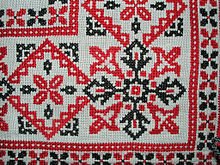
Here is how wikipedia defines "embroidery":
"The art or handicraft of decorating fabric or other materials with needle and thread or yarn. Embroidery may also incorporate other materials such as metal strips, pearls, beads, quills, and sequins
A characteristic of embroidery is that the basic techniques or stitches of the earliest work—chain stitch, buttonhole or blanket stitch, running stitch, satin stitch, cross stitch—remain the fundamental techniques of hand embroidery today.
Machine embroidery, arising in the early stages of the Industrial Revolution, mimics hand embroidery, especially in the use of chain stitches, but the "satin stitch" and hemming stitches of machine work rely on the use of multiple threads and resemble hand work in their appearance, not their construction."
and here is what answers.com says about "embroidery":
"Art of decorating textiles with needle and thread. Among the basic techniques are cross-stitch, crewel work, and quilting. The Persians and Greeks wore quilted garments as armor. The earliest surviving examples of embroidery are Scythian (c. 5th – 3rd century BC). The most notable extant Chinese examples are the imperial silk robes of the Qing dynasty (1644 – 1911/12). Islamic embroideries (16th – 17th century) show stylized geometric patterns based on animal and plant shapes. Northern European embroidery was mostly ecclesiastical until the Renaissance. European skills and conventions prevailed in North America in the 17th – 18th century. The Native Americans embroidered skins and bark with dyed porcupine quills; later the beads they acquired in trade took the place of quills. The indigenous peoples of Central America produced a kind of embroidery with feathers. The Bayeux Tapestry is the most famous surviving piece of needlework."
Sample embroidery
Traditional embroidery in chain stitch on a Kazakh rug, contemporary. (from wikipedia.com)
English cope, late 15th or early 16th century. Silk velvet embroidered with silk and gold threads, closely laid and couched. An example of English embroidery in silk and metal threads, contemporary Art Institute of Chicago textile collection. (from wikipedia.com)
Cross-stitch counted-thread embroidery. Tea-cloth, Hungary, mid-20th century (from wikipedia.com)
Subscribe to:
Posts (Atom)