Here is how wikipedia defines "embroidery":
"The art or handicraft of decorating fabric or other materials with needle and thread or yarn. Embroidery may also incorporate other materials such as metal strips, pearls, beads, quills, and sequins
A characteristic of embroidery is that the basic techniques or stitches of the earliest work—chain stitch, buttonhole or blanket stitch, running stitch, satin stitch, cross stitch—remain the fundamental techniques of hand embroidery today.
Machine embroidery, arising in the early stages of the Industrial Revolution, mimics hand embroidery, especially in the use of chain stitches, but the "satin stitch" and hemming stitches of machine work rely on the use of multiple threads and resemble hand work in their appearance, not their construction."
and here is what answers.com says about "embroidery":
"Art of decorating textiles with needle and thread. Among the basic techniques are cross-stitch, crewel work, and quilting. The Persians and Greeks wore quilted garments as armor. The earliest surviving examples of embroidery are Scythian (c. 5th – 3rd century BC). The most notable extant Chinese examples are the imperial silk robes of the Qing dynasty (1644 – 1911/12). Islamic embroideries (16th – 17th century) show stylized geometric patterns based on animal and plant shapes. Northern European embroidery was mostly ecclesiastical until the Renaissance. European skills and conventions prevailed in North America in the 17th – 18th century. The Native Americans embroidered skins and bark with dyed porcupine quills; later the beads they acquired in trade took the place of quills. The indigenous peoples of Central America produced a kind of embroidery with feathers. The Bayeux Tapestry is the most famous surviving piece of needlework."
Sample embroidery
Traditional embroidery in chain stitch on a Kazakh rug, contemporary. (from wikipedia.com)

English cope, late 15th or early 16th century. Silk velvet embroidered with silk and gold threads, closely laid and couched. An example of English embroidery in silk and metal threads, contemporary Art Institute of Chicago textile collection. (from wikipedia.com)

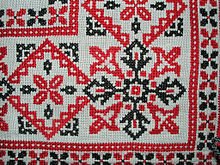
Cross-stitch counted-thread embroidery. Tea-cloth, Hungary, mid-20th century (from wikipedia.com)

No comments:
Post a Comment